What Is the Best Worktop for a Busy Family Kitchen?
The best worktop for a busy family kitchen is one that handles daily use without constant maintenance. For most families in the UK, quartz is the most practical choice: it resists staining without sealing, handles scratches well, and cleans easily with soap and water. Porcelain is a strong alternative for families who regularly place hot pans directly on the surface. This article explains what to look for and how the main materials compare against the real demands of a working family kitchen.
What a Busy Family Kitchen Demands from a Worktop
A family kitchen is used differently to a kitchen in a single-person flat or a rarely-used second home. The worktop is in constant contact with food, liquids, children’s hands, school bags, craft materials, and cooking equipment across the full day. The demands this places on a surface are significant.
Stain resistance matters because spills happen quickly and are not always wiped immediately. A surface that absorbs liquids will stain over time; a non-porous one will not.
Scratch resistance matters because keys, toys, and utensils are placed on the worktop without care. A soft surface will show this wear visibly within a few years.
Ease of cleaning matters because time spent on specialist maintenance is time that most families do not have. A surface that needs oiling, sealing, or specialist cleaning products adds ongoing cost and effort.
Durability under impact matters because children drop things. Edges and corners that chip easily will show damage over time in a high-traffic kitchen.
Heat tolerance matters because the gap between placing a pan on the hob and having hands full of other things is often very short. A worktop that copes with a momentarily placed hot pan is more practical than one that cannot.
Quartz: The Most Practical All-Round Choice for Families
Quartz scores well against most of the demands listed above. Its non-porous surface means it does not absorb spills, so juice, wine, cooking oil, and food residues sit on the surface and can be wiped away without leaving a stain. There is no sealing required at any point in its lifespan.
Quartz sits at around 7 on the Mohs hardness scale, which means everyday contact with keys, ceramic mugs, and cookware does not scratch it noticeably. It is consistent in colour and texture across the slab, which means small surface marks are less visible than on lighter natural stone.
The main limitation for family kitchens is heat sensitivity. The resins in quartz can be damaged by sustained high temperatures. Hot pans placed directly on a quartz surface can discolour or crack the surface over time. In a busy kitchen where trivets are not always remembered, this is a real risk. The practical fix is establishing the habit of using a trivet or silicone mat, which eliminates the problem entirely.
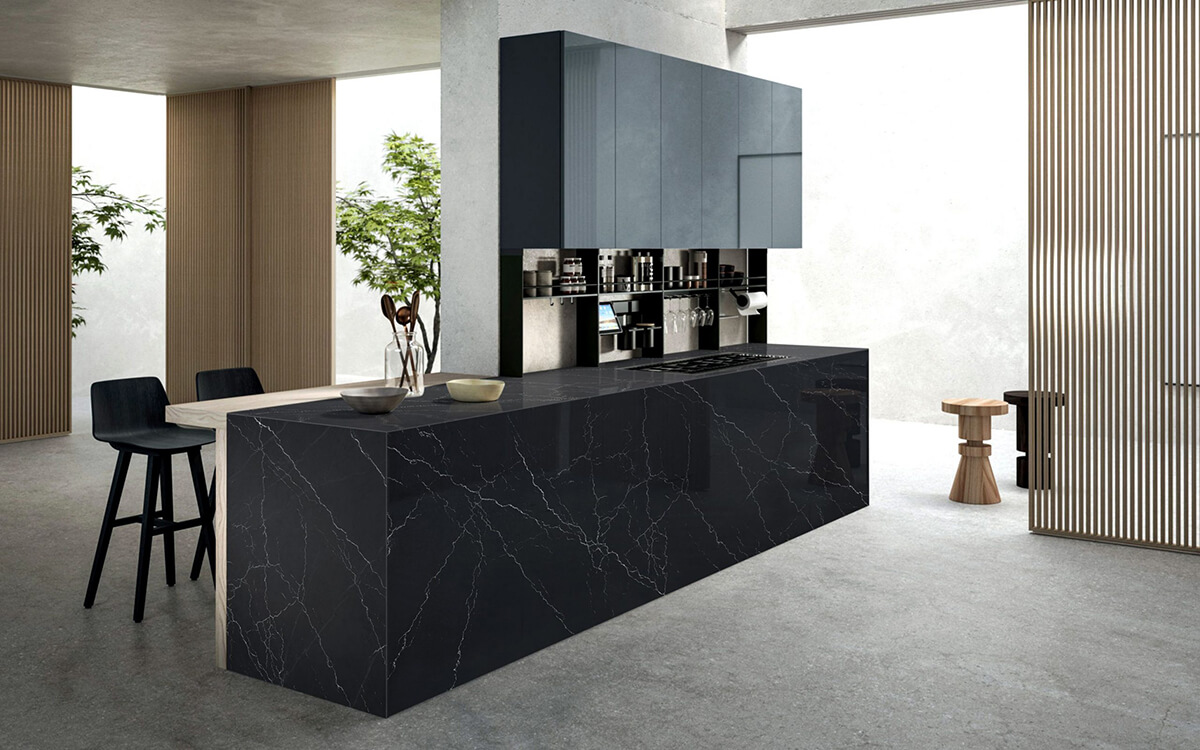
Quartz is available in a wide range of colours and finishes, including darker shades that hide fingerprints and lighter marks better than pale options. For families with young children, mid-tone and darker quartz colours are often the more practical choice for day-to-day appearance.
Porcelain: The Best Choice for Heat Resistance in a Family Kitchen
Porcelain handles heat significantly better than quartz. It is fired at over 1,200 degrees Celsius during manufacture, which gives it a natural resistance to high temperatures that quartz, with its resin content, cannot match. For families where hot pans are moved directly from the hob to the nearest surface, porcelain offers a level of practical protection that quartz does not.
Porcelain is also non-porous and requires no sealing. Stain resistance is comparable to quartz, and cleaning is equally straightforward with warm soapy water.
The consideration with porcelain in a family kitchen is brittleness. Thin-format porcelain (6mm to 12mm) can chip at edges and corners if subjected to a sharp impact from a heavy dropped object. Standard 20mm porcelain is considerably more robust, but it is still slightly more vulnerable to edge chipping than quartz, which benefits from some flexibility introduced by its resin content. For a family kitchen where heavy items are regularly moved around, this is worth bearing in mind when choosing edge profiles and corner finishes.
Porcelain installation also requires experienced fabricators. Across London, Essex, Hertfordshire, and Kent, specialist stone fabricators handle porcelain regularly, but it is important to confirm that your supplier has specific experience with this material rather than treating it as interchangeable with quartz or granite.
Granite: A Practical Option with One Extra Step
Granite is a natural stone that is hard, heat-resistant, and durable across a long lifespan. Its Mohs hardness is broadly comparable to quartz, and it tolerates hot pans significantly better. For families who cook frequently at high temperatures, granite’s heat tolerance is a genuine practical advantage.
The additional step with granite is sealing. Granite is porous and absorbs liquids if not sealed. A correctly sealed granite worktop resists staining well in day-to-day use, but the seal needs refreshing approximately once a year. If a family kitchen has a granite worktop that has not been resealed for several years, staining becomes more likely from red wine, cooking oil, or turmeric-based foods.
The annual sealing process takes around 30 minutes and costs very little using a standard stone sealant from a hardware retailer. For families willing to include this in their annual home maintenance, granite is a strong and durable choice with excellent heat resistance. For families who want a surface that needs no maintenance whatsoever, quartz or porcelain are the lower-effort alternatives.
What About Marble for a Family Kitchen?
Marble is not well suited to a busy family kitchen. It sits at 3 to 4 on the Mohs scale, which means it scratches more easily than quartz, granite, or porcelain. More importantly for families, marble is porous and etches when it comes into contact with acidic substances. In a kitchen where children regularly handle orange juice, vinegar-based condiments, or citrus fruits, acid contact with an unsealed or lightly treated marble surface can leave dull marks that require professional polishing to remove.
Marble is a beautiful material and it suits kitchens where the aesthetic is the priority and the cooking is relatively light. For a family kitchen in regular hard use, the maintenance commitment it requires is higher than most families find practical over the long term.
Laminate in a Family Kitchen
Laminate is the most affordable worktop option and has improved considerably in recent years. Modern laminate products are more resistant to moisture and scratching than earlier generations, and some high-quality formats come close to matching the visual appearance of stone.
Even so, laminate has a lifespan of around 10 to 15 years under regular family use before it begins to show meaningful wear, particularly around the sink, at joins, and along edges exposed to water repeatedly. Stone worktops, by comparison, typically last 20 to 30 years or more.
For families renovating a kitchen they plan to update or sell within a few years, laminate may offer the best value. For families investing in a kitchen they intend to keep for the long term, the cost difference between laminate and quartz narrows considerably when measured across the full lifespan of each material.
Colour and Finish: Practical Considerations for Family Life
The colour and finish of a worktop affect how practical it is on a daily basis, regardless of material. Light-coloured surfaces show dust, crumbs, and fingerprints more visibly than mid-tone or darker options. Highly polished finishes show smears and watermarks more readily than honed or textured finishes. For busy family kitchens, a mid-tone quartz or granite in a honed or slightly textured finish often performs better day to day than a gloss-white polished surface, even though both are equally durable.
Harlow-based fabricators who supply across Essex, London, Hertfordshire, and Kent typically carry a wide range of samples in both materials and finishes. Viewing full-size samples in person before committing to a colour is particularly worthwhile in family kitchens, where the surface will be seen under all lighting conditions throughout the day.
Frequently Asked Questions
What is the most low-maintenance worktop for a family kitchen?
Quartz and porcelain are the most low-maintenance worktop materials for a family kitchen. Both are non-porous, require no sealing, and clean easily with warm water and mild detergent. Neither etches from acidic spills, unlike marble. The main care consideration for quartz is protecting the surface from direct heat; for porcelain, it is protecting edges from sharp impacts. Neither requires ongoing maintenance products or specialist cleaning routines.
Can children scratch a quartz worktop?
Under normal use, children are unlikely to scratch a quartz worktop. Quartz scores around 7 on the Mohs hardness scale, which means it resists scratching from most everyday objects including keys, toys, and ceramic mugs. Cutting directly on the surface with a knife will eventually leave fine marks, but this applies to most worktop materials. Using a chopping board for food preparation is the standard recommendation regardless of which material is chosen.
Is granite safe around children?
Yes. Granite is a safe, robust material well suited to family kitchens. It is non-toxic, hard, and easy to clean. The main practical consideration is that granite requires annual sealing to maintain its stain resistance. If the surface has not been sealed recently, spills from red wine, turmeric, or coffee should be wiped promptly. A correctly sealed granite worktop is no more difficult to manage than quartz in day-to-day family use, and it handles hot pans better.
Which worktop colour is best for a busy family kitchen?
Mid-tone colours in a honed or matte finish tend to perform best visually in busy family kitchens. Very light colours show crumbs, fingerprints, and dust more visibly; very dark colours show watermarks and limescale residue. Mid-tone greys, warm beiges, and neutral stones balance appearance well in most lighting conditions. A honed or textured finish hides day-to-day surface smearing better than a high-gloss polished surface, which requires more frequent wiping to look clean.
How long will a quartz worktop last in a family kitchen?
A properly installed quartz worktop in a busy family kitchen should last 20 to 30 years under normal use. The main risks to longevity are sustained heat from hot pans placed directly on the surface and impact damage to edges and corners from dropped objects. Using trivets for hot cookware and avoiding dropping heavy items on the edge profile eliminates the majority of damage risk. Most quartz manufacturers offer warranties of 10 to 25 years, which reflects the material’s expected longevity in residential use.
About Almaz Worktops: Almaz Worktops specialises in the supply and installation of quartz, granite, marble, porcelain, and quartzite worktops for homeowners and trade clients across London, Essex, Hertfordshire, Kent, and Cambridge. All worktops are fabricated in-house at the Harlow workshop, with a typical turnaround of 7 to 10 working days from template to installation.