
Kitchen Worktop Trends in the UK for 2026
Kitchen worktop trends in the UK for 2026 are being shaped by a clear preference for surfaces that look premium but require minimal upkeep. Marble-effect quartz, large-format porcelain, waterfall edges, and darker stone tones are all appearing with increasing frequency in new kitchen designs across London, Essex, Hertfordshire, and Kent. This article covers the key trends driving kitchen surface choices this year and what each means in practice.
Marble-Effect Quartz and Porcelain: The Dominant Look of 2026
The marble aesthetic has held its place at the centre of UK kitchen design for several years, and in 2026 it shows no sign of retreating. What has changed is the material most commonly used to achieve it. Genuine marble, while visually distinctive, etches from acidic spills, requires regular sealing, and scratches more easily than engineered alternatives. As homeowners have become more aware of its maintenance demands, many are choosing marble-effect quartz or marble-look porcelain instead.
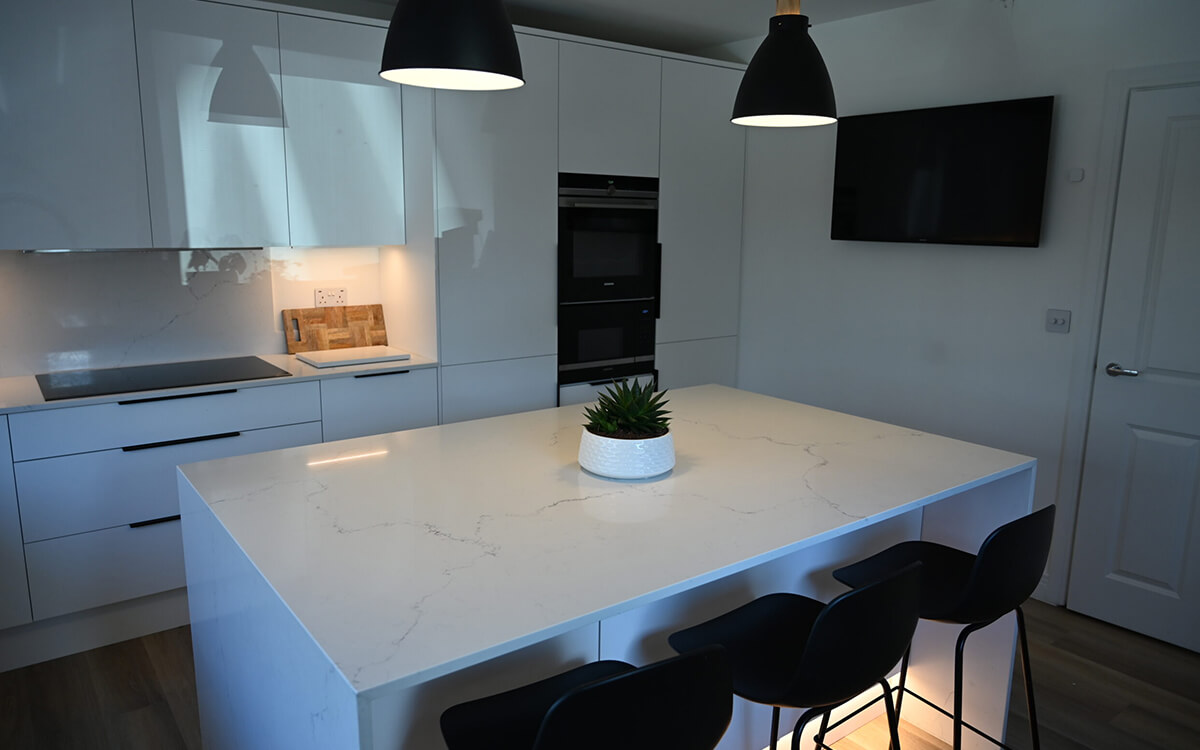
Marble-effect quartz replicates the veining and tonal variation of natural marble using a manufacturing process that embeds the pattern through the slab rather than printing it on the surface. The result is a surface that reads as marble from a distance but performs as quartz in use: non-porous, scratch-resistant, and seal-free.
Large-format porcelain takes the marble-effect concept further. Digital printing technology has reached a level of precision that allows porcelain manufacturers to produce remarkably convincing reproductions of Calacatta, Statuario, and Nero Marquina marble in slabs up to three metres long. For kitchens with long uninterrupted runs of worktop or full-height splashbacks, large-format porcelain delivers a seamless, coherent aesthetic that smaller-format materials cannot match.
Waterfall Edges: From Statement Feature to Standard Expectation
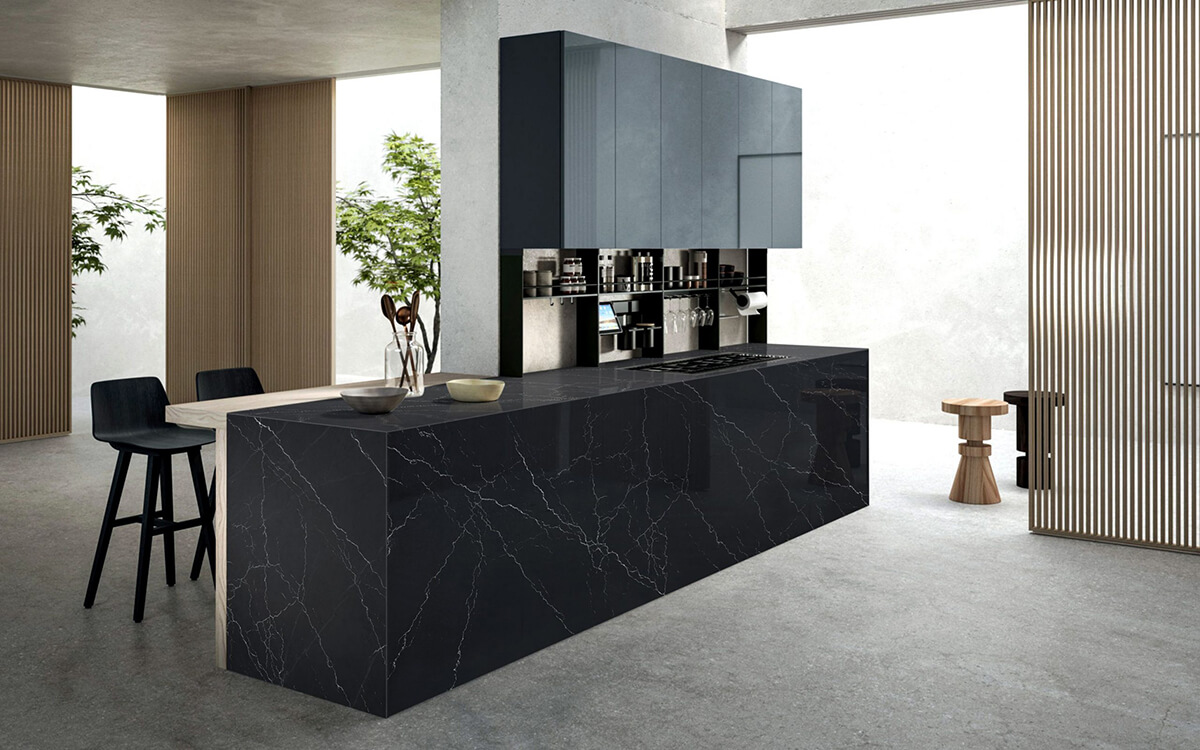
The waterfall edge, where the worktop material continues vertically down the sides of a kitchen island to the floor, has moved from a high-end design statement to a feature that a significant proportion of homeowners now request as standard. Its rise has been driven by social media and the prominence of open-plan kitchen living, where the island is a centrepiece visible from multiple angles.
In practical terms, a waterfall edge requires book-matching: the veining or pattern of the stone must continue from the horizontal surface to the vertical panel in a way that looks intentional and fluid. This demands careful slab selection and precise fabrication. Not every stone suits book-matching equally well; bold, directional veining in quartz or porcelain reads most strongly as a waterfall, while more uniform surfaces can feel flat when taken vertically.
The cost premium for a waterfall edge varies depending on the material and the size of the island, but it is a feature that consistently features in high-specification kitchen designs across the South East. It is worth discussing with your fabricator early in the planning process, as slab selection for book-matching needs to happen before fabrication begins.
Thicker Slabs: 30mm as the New Standard in Premium Kitchens
Worktop thickness has become a visible indicator of specification level. Where 20mm was the default for most kitchen worktops five years ago, 30mm is increasingly specified in premium kitchen projects in 2026. The thicker profile creates a more substantial shadow line at the edge of the worktop, adds visual weight to the surface, and reinforces the impression of quality when viewed from across a room.
Thirty-millimetre stone worktops are heavier than 20mm equivalents and require adequately supported cabinetry, but for most modern kitchen units installed to manufacturer specification, this is not a structural concern. The visual difference between a 20mm and 30mm edge is most apparent on kitchen islands, where the slab edge is visible on multiple sides and the thickness contributes meaningfully to the overall proportion of the piece.
Some designers are also specifying mitred edges on 20mm slabs to achieve the appearance of a 40mm or thicker profile, using two pieces of stone bonded at a 45-degree angle. This gives the aesthetic of a very thick slab at lower material cost and reduced weight.
Darker Surfaces: Charcoal, Forest Green, and Deep Blue Tones
After several years in which light and neutral worktop colours dominated UK kitchen design, darker surfaces are making a significant comeback in 2026. Charcoal and anthracite quartz, deep green granite and quartzite, and near-black porcelain are all appearing with increasing frequency, particularly in kitchens with natural wood cabinetry or in open-plan spaces where contrast is used deliberately.
The appeal of darker worktops is their visual drama. A charcoal quartz on pale Shaker cabinetry creates a strong, considered contrast that works well in both contemporary and transitional kitchen styles. Forest green quartz or quartzite has emerged as a distinctive choice for homeowners who want a surface that feels natural without the maintenance burden of genuine stone.
Practically, very dark surfaces show watermarks and limescale deposits more readily than mid-tones, particularly in areas with hard water. This is a genuine consideration in London and the wider South East, where water hardness is high. Honed or matte finishes on dark surfaces reduce the visibility of watermarks compared to high-polish equivalents, which is worth discussing with your supplier if you are drawn to a very dark option.
Large Kitchen Islands: Worktop as Centrepiece
The kitchen island has continued its trajectory as the defining feature of the modern UK kitchen, and in 2026 it is increasingly the surface around which the rest of the kitchen is designed. Islands are growing in size, with double-sided seating, integrated sinks, and statement stone surfaces that carry visual weight in open-plan living spaces.
For worktop purposes, larger islands mean larger slabs. The ability to cover a substantial island in a single piece of stone, or in as few sections as possible, is a key consideration when choosing material. Porcelain is available in very large format slabs that suit expansive islands with minimal joins. Quartz slabs typically come in standard sizes that may require one or more seams on very long runs, which experienced fabricators plan carefully to minimise visual impact.
Stone islands in 2026 are also being used for more than food preparation. Many homeowners are incorporating full sinks, integrated hobs at the island surface, and flush-fitted accessories, all of which require precise cutout fabrication. The complexity of island worktop work has increased accordingly, and choosing a fabricator with demonstrable experience in complex island installations is more important than ever.
Porcelain for Splashbacks and Full-Height Wall Panels
The integration of worktop material into wall surfaces is a growing trend that extends the visual language of the kitchen beyond the horizontal plane. Full-height porcelain splashbacks, where the same material used for the worktop is taken up to the underside of wall cabinets or ceiling height, create a cohesive, uninterrupted look that has become strongly associated with high-specification kitchen design.
Porcelain is the most practical material for this application. Its large-format slabs can cover significant wall areas with few joins, and its durability makes it suitable for the area behind a hob where heat and grease are present. Matching the worktop and splashback from the same slab or the same batch of production also ensures consistency of colour and pattern that tiling cannot reliably achieve.
Sustainability and Natural Stone
There is a growing interest among UK homeowners in the provenance and environmental footprint of kitchen materials. Natural stone, including granite, marble, and quartzite, is quarried rather than manufactured, which for some buyers aligns with a preference for materials that have not been through an industrial production process involving resins and pigments. The individual variation of natural stone, once seen as a limitation, is increasingly valued as evidence of authenticity.
Quartzite in particular has seen a rise in interest in 2026. It is a natural metamorphic stone that combines the visual appeal of marble with considerably greater hardness and durability. For homeowners who want the aesthetic of natural stone without marble’s etching vulnerability, quartzite represents a compelling alternative.
Frequently Asked Questions
What is the most popular kitchen worktop colour in the UK for 2026?
Marble-effect surfaces in white, cream, and light grey tones remain the most widely chosen kitchen worktop aesthetic in the UK for 2026. Within this, warm-veined Calacatta-inspired quartz and porcelain are particularly prominent. Alongside these, darker tones including charcoal, anthracite, and deep green are growing in popularity as homeowners look for more dramatic contrast in open-plan kitchen layouts.
Are waterfall edge worktops still popular in 2026?
Yes. Waterfall edges have moved from a niche premium feature to a widely requested design element in UK kitchen projects. They are most commonly specified for kitchen islands where the vertical surface is visible from multiple angles, and they work best in materials with strong directional veining such as marble-effect quartz or large-format porcelain. Book-matched waterfall edges require careful slab selection and specialist fabrication planning before the project begins.
Is porcelain or quartz more on-trend for 2026?
Both materials are prominent in UK kitchen design for 2026. Quartz remains the most widely installed kitchen worktop material in the UK due to its broad colour range, established supplier network, and proven performance. Porcelain is growing in specification share, particularly for large-format applications, full-height splashbacks, and kitchens where heat resistance is a priority. For homeowners wanting the most contemporary aesthetic, large-format porcelain in marble or concrete effects is strongly associated with current high-specification design.
What thickness of worktop is most popular in 2026?
Twenty millimetres remains the standard thickness for most UK kitchen worktops, but 30mm is increasingly specified in premium kitchen projects. The thicker profile creates a more substantial edge detail that is particularly visible on kitchen islands viewed from multiple angles. Some designers achieve a similar visual effect using a mitred edge on 20mm stone, which gives the appearance of a much thicker slab at reduced material cost and weight.
Is dark or light stone better for a modern kitchen?
Both work well in modern kitchens, but they suit different design approaches. Light marble-effect surfaces on darker cabinetry create a classic contrast that suits contemporary and transitional kitchens equally. Dark stone on pale cabinetry, such as charcoal quartz with white or cream Shaker units, creates a bold, graphic aesthetic that photographs strongly and suits open-plan spaces. The practical consideration with very dark surfaces is that watermarks and limescale show more visibly, particularly in hard-water areas across London and the South East. A honed or matte finish on dark stone reduces this.
About Almaz Worktops: Almaz Worktops specialises in the supply and installation of quartz, granite, marble, porcelain, and quartzite worktops for homeowners and trade clients across London, Essex, Hertfordshire, Kent, and Cambridge. All worktops are fabricated in-house at the Harlow workshop, with a typical turnaround of 7 to 10 working days from template to installation.